

Protecting Aberdeen Plateau Watersheds with Mobile Water Towers and Fire Engine Relay Systems

Wildfire protection on the Aberdeen Plateau and the Agricultural areas of our region needs to be more than crews waiting at the fire edge. The reservoirs, creeks, wetlands, forests, and agricultural lands in and around the plateau all depend on one thing during a dry fire season: water placed early, in volume, and where it can change fire behaviour.
A mobile water tower strategy gives emergency planners a way to do that. Instead of relying only on fixed hydrants, tanker shuttles, or aircraft drops, the system moves high-volume water projection into the field. Two mobile tower units operating together can dampen about 36 acres in one deployment pattern. Over a three to four-hour operating cycle, with relocation and reset built in, the same units can help treat up to 100 acres of vulnerable ground.
The core idea is simple. Standard fire engines relay water through twin 4-inch supply lines to mobile water towers placed near high-value watershed and agricultural assets. Splitting the flow into two large lines lowers velocity in each hose. Lower velocity means less friction loss. Less friction loss means more water reaches the tower, even when the engines are pushing water over hundreds of metres and, under the right conditions, more than a kilometre.

Why the Aberdeen Plateau needs a field water strategy
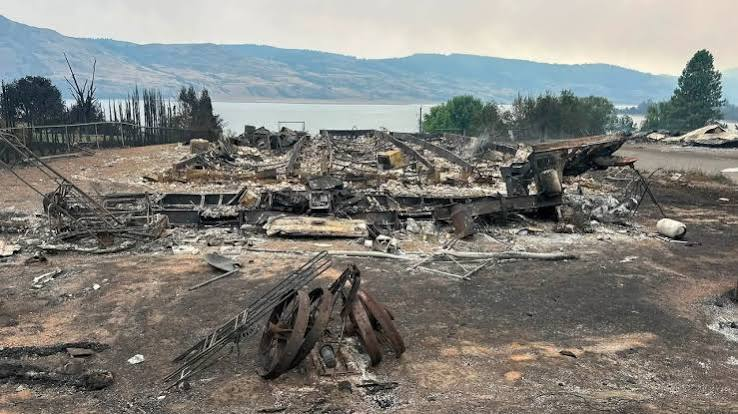
The Aberdeen Plateau is not only a forested highland. It is a water source, a storage area, a working agricultural edge, and a piece of regional fire protection infrastructure. When wildfire burns through a watershed, the damage does not end when flames pass.
A severe burn can affect:
Soil stability on slopes
Sediment movement into reservoirs
Water quality after rain events
Access roads used by crews and equipment
Fences, forage, hay land, and farm infrastructure
Forest regeneration and long-term fuel conditions
This is why pre-positioned water capacity matters. A mobile water tower system does not need to “put out the whole fire” to be useful. Its value comes from cooling fuels, raising surface moisture, lowering flame intensity, and buying time.
That time can help crews protect road corridors, reservoir edges, pump sites, ranch assets, and natural fuel breaks. It can also create safer conditions for dozers, skidders, engines, and hand crews working under an incident command plan.

How mobile water towers fit wildfire protection
Mobile water towers are field-deployed water projection units. They can be moved to the places where water will have the greatest protective effect. In this concept, they are not treated as static sprinklers. They are mobile assets that can be set, supplied, operated, shut down, moved, and reset as fire risk changes.
The proposed deployment is built around two tower units working together.
Operating element | Planning value |
Tower units running together | 2 units |
Estimated coverage per paired deployment | 36 acres |
Operating cycle | 3 to 4 hours |
Setup and breakdown | 2-person crew, where terrain and access allow <30 Min. Set-up/Breakdown |
Potential treated area over repeated moves | Up to 100 acres |
Water delivery method | Standard fire engines in tandem relay |
Supply hose configuration | Twin 4-inch lines |
The practical goal is to dampen key terrain rather than soak every square metre evenly. Crews would focus water where it gives the best return:
Along reservoir margins and access roads
Around pump sites and staging areas
In grass, brush, and timber edges near agricultural land
On slopes where fire intensity could increase quickly
Near values at risk that cannot be moved
This kind of system is most useful when planners identify priority zones before smoke is already on the ridge. Mapping, road access checks, water source planning, and turn-around locations all matter.
The engine relay is the heart of the system
The water tower is only as effective as the supply feeding it. For the Aberdeen Plateau concept, the proposed answer is a tandem relay of standard fire engines using two parallel 4-inch lines.
A single long hose lay can lose a large amount of pressure through friction. As water moves through hose, the hose wall creates drag. The faster the water moves, the greater the loss. This matters more over distance. A few hundred metres of hose may be manageable. A kilometre of hose can become a serious pressure problem if the system is not set up properly.
Splitting the flow across two 4-inch lines helps solve that problem.
Instead of forcing all the water through one hose, the system divides the volume between two. Each line carries less water at a lower velocity. That lower velocity can sharply reduce friction loss, allowing more usable flow to reach the receiving engine or tower.
The advantage of twin 4-inch lines is not only extra capacity. It is lower velocity, lower friction loss, and better volume at distance.
In practical terms, a relay might look like this:
A source engine drafts or pumps from an approved water source.
Twin 4-inch supply lines run to the next engine in the relay.
The second engine boosts pressure and continues the supply forward.
The final engine feeds the mobile tower units.
Operators monitor flow, pressure, hose condition, and tower output.
This layout can support long-distance movement of water across uneven ground, as long as the route, pumps, hose, elevation, and fittings are matched correctly.

Why twin 4-inch lines reduce friction loss
Friction loss can sound abstract, but it is easy to picture. Imagine trying to move a large volume of water through a narrow pipe. The water has to travel fast. Fast water creates more drag against the inside of the hose. That drag turns pump energy into heat and turbulence instead of useful pressure at the nozzle or tower.
Large-diameter hose helps because it gives water more room to move. Twin large-diameter lines help even more because the flow is shared.
For wildfire protection, that has four major benefits.
More water reaches the tower
The tower can project a larger useful stream because the relay preserves more pressure and volume.
Engines work within a more practical range
Pumps do not have to fight as much hose loss, which matters during long operating periods.
Longer lays become possible
With the right terrain and pump spacing, the system can move water from metres away to more than a kilometre away.
The setup stays familiar
Standard engines and common firefighting hose sizes make training, maintenance, and mutual aid easier than a highly specialized system.
This does not remove the need for pump calculations. Elevation gain, hose length, fittings, valves, strainers, and desired tower flow all need to be checked. A one-kilometre relay uphill is not the same as a one-kilometre relay across level ground. The concept works best when fire departments and engineers test it under local conditions before peak season.
Placing towers with skidders and field equipment
A water tower only helps if it can get to the right spot. On the Aberdeen Plateau, that may mean working beyond paved access, near logging roads, range roads, cutblocks, farm lanes, and reservoir service routes.
Logging skidders can help place or reposition mobile towers where road conditions limit larger trucks. Skidders are already built to work on rough forest ground. In a wildfire readiness plan, they could help tow or position tower units, hose bundles, portable tanks, or support equipment, if the units are designed and hitched safely for that use.
This matters because fire protection often fails at the last few hundred metres. A road may get an engine close, but not close enough. A skidder can help bridge that gap where terrain allows.
Good tower placement looks for:
Firm ground with enough room to turn around
Safe distance from heavy fuels where possible
Clear hose routes with limited pinch points
Access for refuelling, inspection, and emergency retreat
Spray coverage over target fuels and structures
Minimal risk of runoff into sensitive water bodies
The tower should not be placed where it causes erosion, damages riparian areas, blocks emergency egress, or traps equipment. Watershed protection means thinking about both fire and water movement.

A three to four-hour cycle creates flexibility
The proposed cycle is one of the strongest parts of the plan. A tower system that takes all day to move can protect only one place. A system that can be set up, operated, broken down, and relocated in a three to four-hour cycle can keep working across a shifting fire edge.
A two-person setup and breakdown crew, where conditions allow, keeps the system lean. The broader operation would still need drivers, pump operators, water supply supervisors, safety support, and incident command coordination. But the field unit itself can remain manageable.
A sample cycle could include:
Cycle phase | What happens |
Site check | Crew confirms access, anchor points, hose route, wind, and escape path |
Setup | Tower is placed, lines are connected, and pump communication is confirmed |
Damping operation | Tower applies water to fuels, edges, and priority protection zones |
Monitoring | Operators watch pressure, coverage, runoff, wind shift, and equipment condition |
Breakdown | Lines are drained or packed as needed, and the tower is readied for movement |
Relocation | Skidder, truck, or other approved equipment moves the unit to the next site |
This is where the acreage numbers become useful. Two towers covering about 36 acres in a paired deployment can protect a meaningful zone around a reservoir edge or agricultural asset. With repeated moves, the same system can dampen up to 100 acres, depending on water supply, access, fuel type, wind, terrain, and crew capacity.
Protecting reservoirs without creating new watershed problems
Using lots of water in a watershed requires care. The aim is to reduce fire severity, not create erosion, sediment, or contamination problems.
Crews should plan tower use around the way water will move after it hits the ground. On steep or bare slopes, too much water in one place can create runoff. Near reservoirs and streams, crews should avoid pushing ash, soil, fuel, or debris directly into the water.
Best practices include:
Apply water in repeated passes rather than flooding one spot
Avoid disturbing stream banks and wetland edges with heavy equipment
Keep fuel, oil, and refuelling activity away from open water
Use existing roads and durable surfaces where possible
Watch for erosion channels after long tower operations
Coordinate with watershed managers before planned deployments
The strategy should also include pre-season mapping. Reservoir intakes, access roads, sensitive crossings, culverts, slopes, and equipment staging zones should be marked before an incident. During a fire, crews have little time to debate where a skidder can safely turn or where a tower should sit.
A mutual aid asset for rural fire response
The mobile water tower and relay model can serve more than one plateau. Once tested and documented, it becomes a mutual aid asset for rural fire departments, First Nations, ranching areas, forestry operators, and local governments facing similar risks.
That matters because many rural areas share the same challenge: they have fuel, distance, limited hydrants, and high-value natural assets. They may have engines, tenders, heavy equipment, and trained operators, but they need a clear way to combine them into a high-volume field water system.
A mutual aid package could include:
Two mobile water towers
Large-diameter hose cache with twin 4-inch lays
Standard coupling and adapter kit
Portable tanks where needed
Pre-written pump relay charts
Skidder-compatible movement plan
Radio communication checklist
Safety and shutdown procedure
Maintenance and winter storage plan
This is where Alberta’s wildfire water tower concepts and field lessons are useful. They show the value of taking water projection out of fixed urban settings and adapting it for rural, forested, and agricultural fire conditions. The Aberdeen Plateau can build from that thinking while fitting the system to local roads, reservoirs, fuels, and response capacity.

What needs to happen before deployment
This strategy should be treated as an operational plan, not just an equipment purchase. The equipment matters, but testing and training matter more.
Before the system protects the Aberdeen Plateau, planners should confirm:
Available water sources and legal access
Drafting points and pump sites
Hose lengths for likely tower locations
Elevation changes along each route
Engine pump capacity and relay spacing
Coupling compatibility between agencies
Skidder routes and tow limits
Crew training needs
Communications between pump operators and tower crews
Withdrawal routes if fire behaviour changes
A live field trial would be the most useful next step. Set two towers, run twin 4-inch lines, use the actual engines likely to respond, and test flows across different distances. Start with shorter lays, then extend the distance. Record pressure, flow, setup time, breakdown time, fuel use, crew needs, and site impacts.
The results would turn the concept into a local playbook. That playbook could guide pre-season staging, mutual aid agreements, training days, and emergency activation.
The practical takeaway
The Aberdeen Plateau needs a wildfire protection strategy that respects both the value of water and the risk of losing the watershed that stores it. Mobile water towers, supplied by a tandem fire engine relay through twin 4-inch lines, offer a practical way to place large volumes of water where they can reduce fire intensity.
The strength of the plan is its mix of mobility and volume. Two tower units can cover about 36 acres at a time. With a three to four-hour operating cycle and planned relocation, they can help dampen up to 100 acres. Skidders can help position towers where roads end or soften. Standard engines and hose make the system easier to train, share, and support through mutual aid.
The next step is field validation. Map the plateau, test the relay, measure the flow, and refine the cycle before the next severe fire season. A system like this will not replace aircraft, crews, fuel treatment, or evacuation planning. It can give them something they all need: more usable water, in the right place, before the fire arrives.


Comments